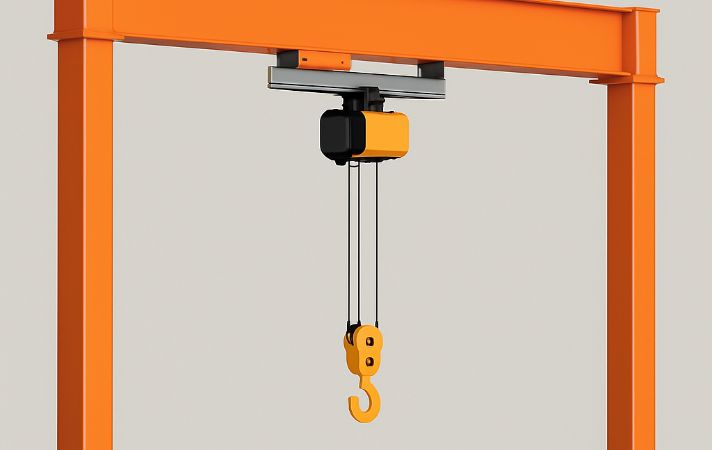

Everything You Need to Know About Davit Cranes: The Ultimate Selection Guide
What Is a Davit Crane?
A davit crane is a versatile, compact lifting device consisting of a vertical mast and an angled or horizontal boom arm. Anchored to a fixed base or dropped into a portable socket, the boom swivels around the vertical axis, allowing operators to lift, lower, and position heavy loads with high accuracy in tight spaces.
Originally developed for maritime vessels to deploy lifeboats and raise anchors, davit cranes have evolved into essential equipment across land-based industries. Today, they are widely used in wastewater treatment facilities, rooftop construction sites, industrial manufacturing plants, and confined space rescue operations.
Unlike large overhead bridge cranes or mobile hydraulic cranes, davit cranes deliver targeted lifting power with a minimal footprint. They can be permanently fixed at a workstation or designed for quick assembly and disassembly, allowing a single portable unit to serve multiple bases across a jobsite.
How Does a Davit Crane Work?
The fundamental operation of a davit crane relies on mechanical leverage and controlled rotation:
-
Vertical Mast: The central column supports the structure and handles axial and bending loads.
-
Angled or Horizontal Boom: Extends outward from the mast to provide reach over a hole, pit, tank, or ledge.
-
Hoisting Mechanism: A manual hand winch, electric wire rope hoist, or pneumatic hoist raises and lowers the load.
-
Rotational Sleeve or Socket: Enables the mast to pivot (typically 360 degrees), allowing the operator to swing the lifted load safely onto solid ground or an adjacent platform.
Because the line of force remains centered over the mounting point, davit cranes maintain a predictable lifting arc. This eliminates dangerous side-loading risks and minimizes sway during vertical movement.
Common Styles and Configurations of Davit Cranes
Davit cranes are not a one-size-fits-all solution. Depending on your environment, lifting frequency, and portability needs, several distinct styles are available:
| Davit Crane Style | Key Features | Typical Load Range | Best Used For |
| Portable Davits | Lightweight, quick-knockdown design; easily moved between socket bases |
Up to 1,000 kg (2,200 lbs) |
Servicing multiple pits, sumps, or rooftop locations |
|
Stationary / Fixed Davits |
Heavy-duty steel mast mounted permanently to concrete or steel structures |
Up to 2,500+ kg (5,500+ lbs) |
High-frequency industrial lifting at dedicated workstations |
| Manual Winch Davits | Operated by hand-crank with automatic load-actuated brakes | 250 kg – 1,000 kg | Sites without power; low-frequency or emergency rescue operations |
|
Electric / Powered Davits |
Powered wire rope or chain hoist for effortless, rapid vertical lifting | Up to 3,000+ kg | Repetitive lifting, heavy equipment maintenance, and deep lifts |
|
Telescoping Boom Davits |
Adjustable boom reach and clearance height under load or un-loaded |
Varies by extension length |
Workspaces requiring variable reach over obstacles |
|
Composite / Aluminum Davits |
High strength-to-weight ratio; corrosion-resistant construction |
Up to 600 kg (1,300 lbs) |
Single-person transport and harsh/corrosive chemical environments |
1. Portable Davit Cranes
Portable models are constructed from high-strength aluminum or lightweight tubular steel. They break down into two or three easy-to-carry components (mast, boom, and winch) without special tools. A single technician can carry the crane to a site, insert it into a pre-installed socket, execute the lift, and stow the crane back in a utility vehicle.
2. Stationary Davit Cranes
Designed for permanent mounting, stationary davit cranes offer higher working load limits (WLL) and longer boom reaches. They feature robust structural steel framing and welded base plates that bolt directly into concrete foundations or structural steel beams.
3. Manual vs. Powered Hoist Configurations
-
Manual Winches: Feature spur gear or worm gear mechanisms with internal friction brakes. Ideal for remote field environments lacking electrical power.
-
Electric or Pneumatic Hoists: Essential for repetitive maintenance—such as pulling submersible pumps out of deep wastewater sumps—reducing operator fatigue and job cycle times.
4. Telescoping and Adjustable Booms
Many modern davit designs incorporate telescoping booms with variable height and reach options. Adjusting the boom angle or length changes the lifting geometry, allowing operators to clear guardrails, walls, or overhead piping.
Mounting Options for Davit Cranes
The safety and performance of any davit crane depend heavily on its mounting interface. Common base options include:
-
Pedestal Bases: Surface-mounted to reinforced concrete floors or steel platforms using anchor bolts.
-
Flush-Mount Sockets: Cast directly into pour-in-place concrete decks, leaving a flush surface free of trip hazards when the crane is removed.
-
Wall-Mount / Structural Brackets: Secured to vertical concrete walls or steel columns to maximize clear floor space.
-
Wheel Bases / Mobile Carts: Counterbalanced wheeled bases that allow portable davit cranes to move freely across flat shop floors.
Unsure which base style or load rating fits your site infrastructure? Get a customized davit crane quote.
Request a Quote →Primary Applications Across Industries
Davit cranes provide tailored lifting solutions across a broad range of sectors:
Water & Wastewater Facilities
Submersible pumps, mixers, gearboxes, and stop logs require routine removal for servicing. Fixed socket bases installed at every tank hatch allow one portable davit crane to service an entire facility.
Marine, Shipping & Offshore
From commercial ships to offshore wind platforms, davit cranes handle anchor recovery, supply transfers, and lifeboat deployment. Marine-grade finishes (such as hot-dip galvanizing, stainless steel, or multi-coat epoxy systems) protect against saltwater corrosion.
Construction & Rooftop Maintenance
Lightweight aluminum davit cranes are frequently hoisted to rooftops to lift tools, HVAC units, materials, and servicing equipment from ground level without requiring expensive mobile hydraulic crane rentals.

Confined Space Entry & Personal Retrieval
When paired with certified fall arrest blocks and personnel winches, davit systems serve as stable overhead anchors for lowering workers into vaults, manholes, and silos—and retrieving them safely in an emergency.

Key Advantages of Davit Cranes
-
Cost Efficiency: A single portable davit crane can service dozens of low-cost socket bases across a single jobsite, drastically cutting equipment expenses.
-
Space-Saving Design: Eliminates the wide footprint required by traditional gantry or mobile floor cranes.
-
Enhanced Jobsite Safety: Eliminates dangerous manual lifting practices and minimizes improvisational rigging over edges or hatches.
-
Precision Control: Slewing bearings and smooth winch drives enable steady, controlled load positioning.
Essential Safety and Maintenance Guidelines
To maintain compliance with occupational safety regulations and ensure long equipment service life, follow these core practices:
-
Understand Capacity Ratings: A davit crane's Working Load Limit (WLL) changes when the boom is extended or angled downward. Always consult the crane's load chart before rigging a load.
-
Inspect Wire Ropes and Winches: Check daily for kinking, fraying, bird-caging, or corrosion on wire ropes. Verify winch brake engagement before making a lift.
-
Verify Mounting Integrity: Ensure mounting sockets and structural concrete or steel show no signs of cracking, bolt loosening, or fatigue.
-
Schedule Annual Certification: Have certified rigging inspectors conduct annual load testing and thorough non-destructive examination (NDE) as required by regional safety standards.
How to Choose the Right Davit Crane
When specifying a davit crane for your workplace, consider these five key factors:
-
Required Capacity (WLL): What is the heaviest object you will lift, including rigging hardware?
-
Lifting Height & Reach: How far over the opening must the boom extend, and how far below the base must the hoist line drop?
-
Operating Environment: Will the crane be exposed to harsh outdoor weather, chemical washdowns, or saltwater marine environments?
-
Portability vs. Permanence: Will the crane stay in one location, or do you need a single unit to service multiple stations?
-
Power Availability: Is electrical or pneumatic power readily available, or is a manual hand winch required?
Ready to upgrade your material handling capabilities or need certified crane inspection services? Contact the Hercules Technical Sales Team.
Contact Us →