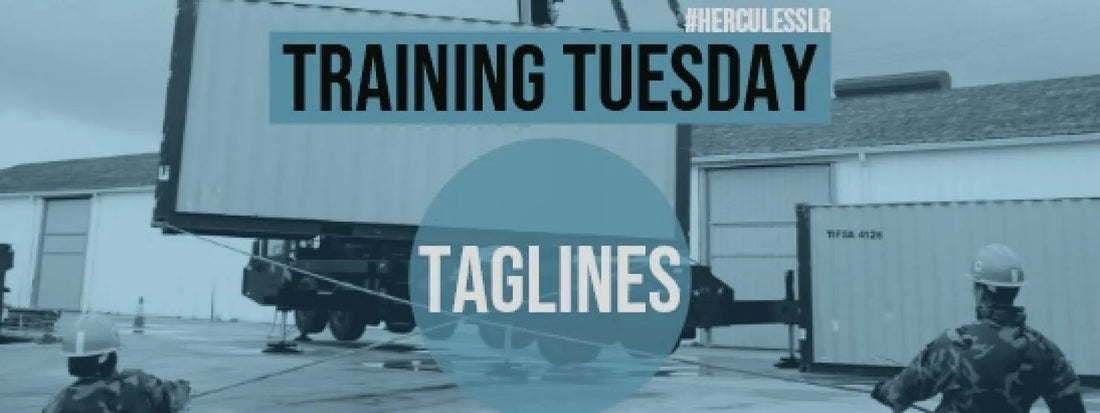
Tagline Safety Tips for Crane Lifting | Training Tuesday
Taglines help rigging teams guide suspended loads without placing their hands directly on the load. However, adding a rope does not automatically make a lift safer. The line, its attachment, the handler's position, and the surrounding work area all need consideration before lifting begins.
In this Training Tuesday guide, Hercules explores what taglines do, when they may be appropriate, and which hazards deserve attention. Use this article as an awareness resource alongside practical training, equipment instructions, and a task-specific lifting plan, not as a complete operating procedure.
What Are Taglines in Lifting and Rigging?
A tagline is a line attached to a load to help control its orientation during movement and landing. Often made from synthetic rope, it allows a designated handler to influence rotation while remaining away from direct contact with the suspended object.
A tagline is not the lifting sling, hoist rope, or load-supporting connection. Its purpose is guidance, not supporting the load's weight. It also cannot correct unsuitable rigging, an unidentified centre of gravity, or an unsafe lifting path.
When Might a Lift Need Taglines?
The lifting team should assess whether a tagline offers useful control without exposing the handler to greater risk. Examples might include positioning a long component or guiding an item toward a planned landing area. Suitability depends on the whole operation, not simply the load's shape.
If the arrangement would pull someone toward an edge, trap them beside a structure, or require entry beneath the load, reassess the method. Choosing a different handling approach may be more appropriate than adding a tagline.
Plan the Lift Before Attaching a Tagline
Review the load, lifting route, landing position, and surrounding activities before choosing the line arrangement. Consider where the handler will stand at each stage, including when the load changes height or direction. A position that works at the start may become unsuitable later.
Discuss the following during the pre-lift briefing:
- The specific purpose of each tagline and who will handle it.
- The planned load path and areas that must remain clear.
- Potential snagging points, sharp surfaces, and moving equipment.
- Communication methods and the procedure for stopping the lift.
- How the load will be landed, secured, and disconnected.

Tagline Selection and Pre-Use Checks
Check Line Condition
Examine the line for cuts, abrasion, damaged ends, contamination, and other concerns before use. Follow the supplier's guidance for inspection and suitability. Do not assume that a rope found nearby is appropriate simply because it appears strong enough.
If the condition or intended use is uncertain, set the line aside for assessment. Identification and equipment records can help the team distinguish suitable gear from rope used for unrelated tasks.
Consider Length and Attachment
The line must suit the planned working positions and load movement. Too little reach can draw the handler closer to the load, while unmanaged excess can create trips or snagging hazards. Plan how the line will be controlled throughout the operation.
Attachment locations should be established through the lifting plan and equipment guidance. Avoid treating one location, such as the extreme end of every load, as a universal rule. Access, geometry, and the consequences of tension all matter.

Handler Positioning and Line Management
The handler needs a clear working area, stable footing, and a route away from danger. Consider the space around the worker as well as the load. Nearby walls, stored materials, vehicles, and openings can turn ordinary movement into a trapping or fall hazard.
Never wrap the line around a wrist, hand, waist, or other body part. The worker must not become physically tied to a moving load. Keep feet clear of loops and avoid allowing loose line to collect where people walk.
Do not move beneath a suspended load to retrieve a dropped tagline. Stop and use the site's planned procedure to resolve the situation rather than improvising while the load remains in motion.

Communication During Crane Lifting
Before starting, confirm who directs the crane operator and how tagline handlers communicate concerns. Several people giving different instructions can create confusion. Use the site's agreed signalling and radio arrangements, including a clear stop-work procedure.
Handlers should report unexpected rotation, snagging, restricted movement, or loss of a safe position immediately. They should not try to compensate for uncontrolled motion by pulling harder or placing themselves closer to the hazard.
Weather, Obstacles, and Other Tagline Hazards
A tagline does not make adverse weather acceptable. Wind and other conditions must remain within the limits established for the equipment and lifting operation. If the team cannot maintain control within the planned method, stop and reassess rather than relying on extra manual force.
Also consider contact with electrical hazards, rotating machinery, protrusions, and adjacent structures. Do not assume synthetic rope provides electrical protection. Specialist environments, including offshore transfers, require their own assessment and procedures rather than a generic tagline rule.
Landing the Load and Completing the Lift
The landing stage deserves the same planning as the initial pick. Confirm that supports and the receiving area are ready, and keep workers clear of pinch points as the load approaches its destination.
Remove taglines and lifting connections only when the load is appropriately supported and secured under the agreed procedure. Afterward, inspect and store the line according to its instructions, reporting damage or unusual events before the next use.
Training and Key Takeaways
Practical training should connect load-control principles with the actual equipment, site layout, and team responsibilities. Review the method whenever the task or conditions change. A previous successful lift does not establish that the same arrangement suits a different load.
Taglines are useful only when they support a well-planned operation without creating greater hazards. Keep handlers clear of suspended loads, manage the line deliberately, communicate early, and stop when conditions depart from the plan.
Build Your Team's Rigging Knowledge
Explore Hercules training options, or contact Hercules to discuss equipment and training requirements for your team's work.
Explore Training →Contact Hercules →


 In Stock