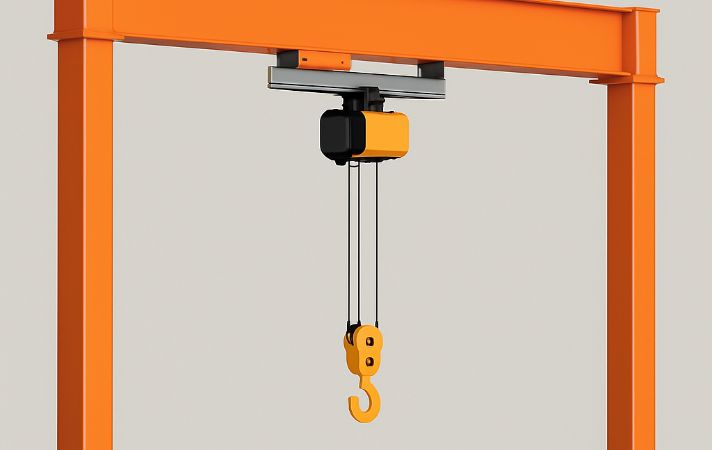

Push the Limits? Understanding Overhead Crane Capacity Limits
At Hercules Crane & Lifting Supplies, safety and structural integrity are at the core of everything we do. One of the most critical questions facility managers, maintenance supervisors, and production teams ask us is: Can an overhead crane ever be operated beyond its rated capacity?
The direct answer is no—under typical day-to-day conditions, you must never exceed the stated load capacity. Pushing past these boundaries invites catastrophic structural failure, severe mechanical breakdown, and extreme hazards to personnel.
However, regulatory standards do recognize that specialized, infrequent situations arise. Industry guidelines establish a strict, highly regulated process known as controlled overhead lifting to accommodate these rare demands safely.
If you are evaluating your current rigging setups or designing a new facility layout, navigating these legalities and physical limits is essential.
Not sure if your crane is sized right for your facility?
Our lifting specialists will assess your load requirements, duty cycle, and compliance obligations—at no cost.
Book a Free ConsultationThe Strict Rules of Controlled Overload Lifting
A standard lift should never push a hoist past its safe working load. Yet, under the governing framework of the CSA-B167 standard (which integrates heavily with ASME B30 safety codes), a crane may occasionally lift an exceptional load if it meets seven absolute criteria.
Because an intentional overload introduces severe risk, these parameters must be flawlessly executed:
1. Absolute Maximum Ceiling: 125%
The maximum weight for a controlled overload must never exceed 125% of the crane's official rated capacity. For instance, if your facility operates a 10,000 kg Hercules overhead crane, the absolute limit for an exceptional lift is 12,500 kg. Anything higher is strictly forbidden without massive structural re-engineering.
2. Annual Frequency: Maximum of 2 Times
This type of deviation is reserved strictly for special, irregular events. You are legally limited to a maximum of two overload lifts within any rolling 12-month window. If your operational demands require heavier lifting more frequently than twice a year, the system must undergo a rigorous evaluation of all its structural, mechanical, electrical, and hydraulic components to prove they can survive the repeated fatigue.
3. Engineering & Manufacturer-Approved Lifting Plan
You cannot simply attach a heavy load and hope for the best. A comprehensive lifting strategy must be drafted by a qualified expert and formally signed off by a professional engineer, explicitly working alongside the equipment manufacturer. Furthermore, the plan must mandate that the entire lift zone is entirely cleared and all on-site personnel are warned before the hoist engages.
4. Mandated Buffer Zones
During a controlled overload event, the surrounding area becomes a high-hazard zone. No one is permitted to stand nearby, and the load path must be entirely clear of personnel.
5. Two-Stage Equipment Audits (Before & After)
Prior to rigging the load, a certified technician must complete a thorough pre-lift inspection to fix any hidden wear or mechanical defects. Once the overload lift is completed, the system cannot return to normal production until a second full inspection confirms that no structural stress fractures, gear damage, or component distortions occurred during the operation.
Need a certified pre-lift or post-lift inspection?
Hercules technicians are CSA-B167 trained and available across Canada. Keep your crane compliant and your crew safe.
Request an Inspection6. Crane Runway and Support Structure Verification
An overhead crane is only as reliable as the building holding it up. A professional engineer must review, inspect, and approve the entire crane runway, structural columns, and foundation. This engineering calculation must explicitly account for any existing wear, material fatigue, or degradation in the building's infrastructure.
7. Permanent System Performance Records
Every detail of the exceptional lift—including the calculated weights, engineered plans, structural reviews, and inspection findings—must be logged in the crane's permanent service history file.
Sizing Your Equipment: Match Your Long-Term Goals
When purchasing a new overhead crane system, choosing the right capacity requires looking beyond the price tag. While buying a higher-capacity crane demands a larger upfront investment, relying on temporary "controlled overloads" to save a bit of money can ruin your facility's daily productivity.
Consider these two distinct scenarios:
-
Scenario A: Your daily operations never exceed 5 tons, but you have a specialized machine weighing 6 tons that needs to be moved exactly once a year for annual servicing. If you can fully commit to the 7 stringent safety conditions listed above, selecting a 5-ton Hercules overhead crane is a viable, safe, and cost-effective strategy.
-
Scenario B: You have that same 6-ton machine, but it requires maintenance or relocation every quarter. Because this exceeds the "twice a year" threshold, a standard 5-ton system will not legally cut it. The constant logistical hurdles, safety shutdowns, and required engineering audits will drain your productivity. In this case, stepping up to a 7.5-ton or 10-ton crane system is the only logical choice for your business.

Trust the Lifting Experts
At Hercules Crane & Lifting Supplies, we don't just supply cranes—we design comprehensive, compliant lifting solutions tailored to your real-world workflows. Whether you need to audit your current system's structural integrity, draft an engineered lifting plan, or custom-build a brand-new overhead crane engineered for growth, our team is ready to assist.
Reach out to Hercules today to ensure your facility stays safe, compliant, and powerfully efficient.
Ready to build a compliant, high-performance lifting system?
From engineered lifting plans to custom overhead crane solutions, Hercules has you covered from spec to installation.
Get a Custom Quote