

Rigging in High-Density Tech Environments: Data Centers & Microchip Fabs
The unprecedented global demand for artificial intelligence infrastructure, cloud computing, and domestic semiconductor manufacturing has triggered a massive construction boom. Tech giants and chipmakers are investing hundreds of billions of dollars into sprawling data centers and highly advanced microchip fabrication plants (fabs).
While these facilities look like massive, simplified warehouses from the outside, their interiors are some of the most densely packed, high-stakes industrial environments on earth.
For rigging engineers, the challenge isn't just the sheer weight of the equipment—it's the environment itself. Maneuvering multi-million dollar air handling units (AHUs), massive uninterruptible power supply (UPS) systems, industrial generators, and sensitive photolithography machines into tight interior spaces requires a complete departure from traditional crane operations. When overhead clearance is measured in inches and a single stray vibration can ruin a million-dollar batch of silicon wafers, you need to rely on restricted clearance engineering.

Engineered for Precision Environments
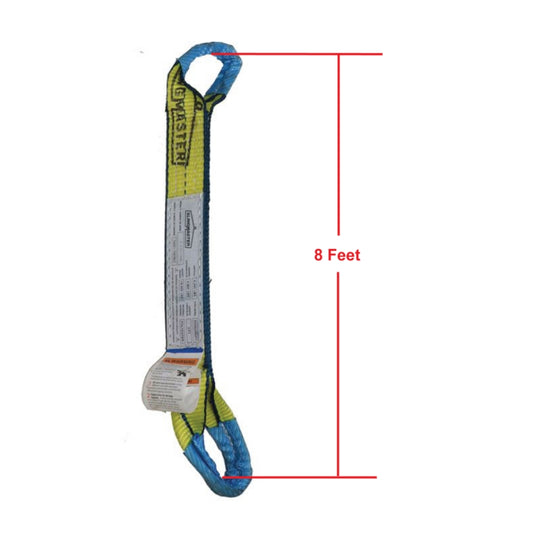
Explore our certified lifting slings rated for sensitive, high-value equipment lifts.
Shop Lifting SlingsThe Spatial Reality: Restricted Clearance Engineering
In a standard industrial setting, if a heavy piece of machinery needs to be placed deep inside a building, a roof hatch is left open, or an exterior wall is left unsealed so a high-capacity mobile crane can pick and set the load.
Data centers and microchip fabs do not afford this luxury. Due to strict building envelope requirements for environmental containment, security, and climate control, rigging crews are routinely forced to bring massive components through narrow loading docks and transport them down long, low-clearance utility corridors known as "clean sub-fab" areas or white space galleries.
The Limits of Overhead Cranes
Traditional mobile or overhead cranes are instantly ruled out in these environments due to low overhead structural steel, existing cable trays, and complex HVAC ductwork. If a rigging beam or boom cannot fit, engineers must transition from vertical lifting to horizontal transport systems that distribute weight seamlessly across concrete slabs.
Two core technologies dominate this space: Hydraulic Gantry Systems and Air Caster Systems.

Tooling for Tight Spaces: Gantries and Air Casters
When overhead space is severely limited, rigging crews must create their own temporary, mobile lifting frames.
Low-Headroom Hydraulic Gantries
Hydraulic gantries are the workhorses of interior tech rigging. These systems utilize telescopic legs mounted on specialized tracks to lift, travel, and omit loads without the need for a massive counterweight footprint.
In a data center environment, a four-point hydraulic gantry system can be assembled around a heavy generator or chiller outside the tight envelope, lift it slightly, slide it through a low-clearance doorway on its track system, and lower it precisely onto its anchoring bolts. Modern systems feature wireless, synchronized control units that ensure all four lift points extend at exactly the same rate, preventing dangerous load shifts in tight quarters.
Air Caster Technology: Floating on a Cushion of Air
When overhead clearance is virtually non-existent, or when the floor loading capacity prevents the concentrated weight of wheels or rollers, rigging teams turn to air casters (or air bags).
Air casters operate on a surprisingly simple aerodynamic principle. Specialized polyurethane bags are attached to the bottom of a steel load module. When pressurized compressed air is forced into the caster, it inflates and bleeds air out of the bottom perimeter, creating a microscopic film of air—usually only a few thousandths of an inch thick—between the caster and the floor.
Because the coefficient of friction is nearly eliminated, a rigging team can manually push a 50-ton electrical transformer down a narrow corridor with just a few pounds of manual force, or by utilizing small, precise battery-powered tuggers.
Additionally, because air casters distribute the weight of the load evenly across a broad surface area, they prevent the high point-loading that can crack expensive anti-static epoxy floor coatings.
Need a Gantry Solution for Tight Spaces?
Our portable and adjustable gantry cranes are built for confined, high-precision environments like data centers and fabs.
Explore Gantry CranesCleanroom Rigging Protocols: Zero Contamination Tolerances
While data centers require extreme cleanliness, microchip fabs operate on a level of environmental containment that rivals aerospace biology labs. In a Category 1 (ISO 1) cleanroom, even a single speck of dust or airborne particle can settle on a silicon wafer, instantly destroying thousands of microchips.
Bringing heavy rigging gear into an active fab requires adhering to strict cleanroom rigging protocols:
-
Equipment Off-Gassing and Material Selection: Standard rigging gear relies on grease, hydraulic oil, and shedding materials like nylon or bare steel. For cleanrooms, rigging equipment must be completely stripped of off-gassing polymers. Hydraulic fluids must be food-grade or synthetic, and gantries are often wrapped in protective membranes to catch stray micro-droplets of oil.
-
Non-Shedding Materials: Wood cribbing, a staple of traditional rigging, is strictly banned in tech environments because it sheds organic particulate. Rigging teams instead use high-density polyethylene (HDPE) or anodized aluminum blocking.
-
Multistage Decontamination: Before any air caster, beam, or jack enters the cleanroom envelope, it must undergo a multi-stage washdown. Gear is pressure washed in a dirty bay, wiped down with isopropyl alcohol (IPA) in a transition zone, and inspected via particle counters before crossing the threshold.

The Ultimate Challenge: Zero-Tolerance Vibration Limits
Perhaps the most technically demanding aspect of rigging inside a microchip fab or an operational data center is the mitigation of kinetic energy.
Microchip fabrication relies on photolithography machines that use extreme ultraviolet (EUV) light to etch microscopic circuits onto silicon. These machines operate with tolerances measured in nanometers. If a rigging team drops a heavy steel plate, drags a heavy load roughly across an expansion joint, or uses a high-vibration power tool nearby, the resulting shockwave traveling through the building's concrete slab can ruin millions of dollars of active production.
Structural Isolation Techniques
To combat this, rigging engineers must perform extensive kinetic analysis prior to the move:
-
Vibration Monitoring Arrays: Seismic sensors are placed on the building's structural columns and near sensitive tool bays to establish a baseline. During the rig, these sensors stream real-time telemetry to the rigging supervisor. If a threshold is approached, work stops instantly.
-
Transition Ramp Engineering: When a load must cross an expansion joint or a slight floor variance, rigging teams construct custom, decoupled transitions using dampening rubber layers beneath aluminum plates. This smooths out any micro-bumps, ensuring the air casters or rollers glide across the threshold without transferring dynamic impact forces into the foundation.
Summary: A New Paradigm for Heavy Rigging
The booming tech landscape has elevated heavy rigging from a trade of brute force to an exercise in surgical engineering. Maneuvering critical infrastructure into data centers and microchip fabs requires a meticulous blend of spatial mathematics, advanced horizontal fluid dynamics via air casters, and an absolute respect for environmental cleanliness and seismic isolation. For modern rigging firms, the future of the industry isn't just about lifting heavier—it's about moving smarter in the tightest spaces on earth.
Planning a Critical Lift in a Tech Facility?
Our rigging specialists are ready to help you plan, certify, and execute lifts in the most demanding environments.
Talk to a Rigging Specialist


 In Stock